


Why did the 10-minute delivery have to go?

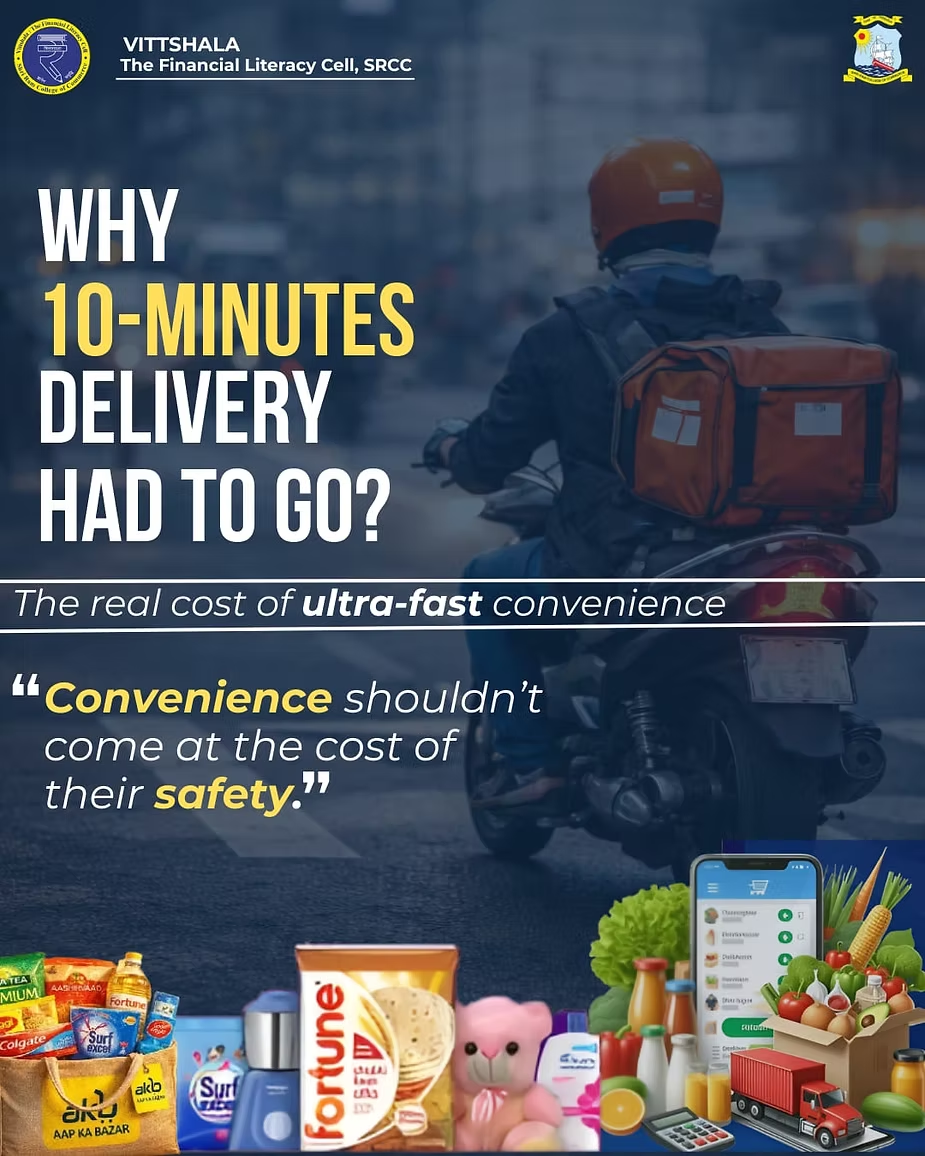
Introduction-
The collapse of the 10-minute delivery claim exposes a deeper truth about progress that runs on invisible labour. It was a marketing promise made by quick commerce platforms that groceries and daily essentials would be delivered to the customers within ten minutes of placing an order, this promise emerged as one of the boldest claims in India’s quick commerce revolution. Platforms like Zepto, Swiggy, Instamart, and Blinkit marketed this idea as a total breakthrough in convenience shopping. It was built on the idea of extremely close proximity “dark stores” which are small warehouses designed exclusively to fulfill online orders, and dense urban coverage, which allowed companies to project never before seen speed and proximity. The whole ecosystem of the 10 minute delivery model worked through the delivery agents. These agents are an essential part of the gig economy in India, forming a massive workforce that powers food delivery, cab and other e-commerce platforms. These workers are often young, economically impoverished and compelled to do this work because of lack of better, more stable work opportunities and the 10 minute delivery model placed even more strain on these workers who were barely getting by to begin with.
The claim had a very significant and immediate impact on the customers' minds. They began to see the groceries not as planned purchases but instead as instant access commodities. To customers waiting even 10 to 15 minutes which was once considered super fast now started seeming excessive and irritating. Ultra-fast delivery functioned as a powerful tool of convenience finance as by stripping away the friction normally involved in spending, platforms nudged users to order more frequently and with less deliberation.
The need for the claim stemmed from the intensely competitive nature of the quick commerce industry as all the platforms offered similar products, pricing and app experience, differentiation was a cumbersome task. Amidst came the 10 minute delivery promise which was easy to understand, hard to ignore and powerful enough to divide the market into two blunt categories: platforms that were fast, and platforms that were irrelevant. Investor pressure also played a decisive role as most of these companies were VC funded and venture funded startups are expected to demonstrate rapid growth, which was otherwise impossible in such a crowded market.
Operational Reality-
The operational reality of the 10 minute delivery claim is completely different from the marketing narratives as to meet the unrealistic delivery targets, delivery agents frequently engaged in unsafe practices. Skipping signals, riding on the wrong side of the road and speeding through congested areas became a routine task for the delivery agents. India’s already hazardous urban traffic environment increased the risks. While companies publicly denied incentivising dangerous behaviour, internal performance metrics, ratings systems and penalty structures were completely opposite to these empty claims and hence, the workers broke traffic rules not out of carelessness but out of necessity. The mental health toll on delivery agents was equally severe as constant time pressure, fear of penalties and customer dissatisfaction created an environment of chronic stress. In several interviews these gig workers reported anxiety, burnout and physical exhaustion and the algorithmic management systems used by platforms often reduced human interaction to metrics, leaving workers feeling disposable and unheard.
Public Scrutiny and Media backlash-
As public awareness grew, the 10 minute delivery model came under intense scrutiny. Social media played a critical role in amplifying worker voices, accident reports, and ethical concerns as videos of delivery agents risking their lives for groceries went viral which sparked massive outrage. The narrative completely shifted from technological and logistical innovation to discomfort about human cost and the same innovation now began to look like exploitation. Media outlets began investigating the realities behind the promise as articles highlighted road safety risks, insecurity among the labour classes and the disconnect between corporate messaging and ground realities. The discourse expanded beyond individual companies to question the broader gig economy model and strikes and protests by delivery agents, though often fragmented and inconsistent, signalled growing dissent. Public trust in these platforms began to erode particularly among socially conscious consumers who started questioning whether ultra fast convenience was worth the price paid by workers.
Regulatory Pressure-
Regulatory pressure soon followed public criticism as government authorities raised concerns about traffic safety, pointing out that no delivery timeline should encourage rule breaking. Road safety agencies warned that speed based incentives increase accidents and fatalities. Further, labour departments began examining whether gig workers were being indirectly coerced into unsafe working conditions and the absence of clear labour protections for gig workers became a focal point of policy discussions. In response, authorities urged e-commerce and quick commerce platforms to reconsider their delivery claims as the issue was not just the wording but also the behavioural consequences entangled with the promise. Regulators recognised that even if companies did not explicitly mandate unsafe practices, the structure of incentives effectively did and hence the 10-minute claim was seen as incompatible with public safety and responsible employment standards.
Companies finally dropped the claim-
Facing mounting pressure from both the media and regulatory agencies, major platforms eventually dropped the explicit 10 minute delivery claim and companies rebranded their services using softer language such as “fast delivery” or extended the promised window to 30 minutes. Publicly, these changes were framed as alignment with regulatory guidance and a commitment to safety, however, the underlying business model remained largely intact. Deepinder Goyal, the founder of Eternal Group which is the parent company of platforms like Zomato and Blinkit, in an interview claimed that the app did not actually show riders a 10 minute deadline and that delivery partners were not instructed to rush or break traffic rules. But, the statement was not backed by reality as the system still communicated urgency indirectly through estimated delivery times, performance ratings and penalties for delays. Hence, even while the wording changed, the incentive structure did not undergo meaningful reform. Delivery agents continue to be rewarded for speed, penalised for delays and evaluated through opaque algorithms.
This raises deeper ethical questions about development and progress in a rapidly growing economy like India’s where the aspirations of the rich are being laden on the back of the poor and the struggling. Quick commerce which symbolises modern urbanisation and a digital transformation, is fuelled by informal labour operating under constant pressure. The convenience enjoyed by middle and upper class consumers often comes at the expense of workers with limited alternatives. While the removal of the 10 minute delivery claim marked an important symbolic shift acknowledging that certain promises are socially unsustainable, without necessary structural changes to the gig economy the fundamental issues remain unresolved, while speed continues to be monetised the workers remain exploited. By - Hiten


Comments